
Thanks For The Visit !
Farmboyzim's Freeware Finds
The B-36H "Peacemaker"
By Farmboyzim
The B-36H "Peacemaker"
By Farmboyzim

In this corner, weighing in at 357,500 pounds (give or take), the B-36H Peacemaker! This mammoth of an aircraft was made by the Convair aircraft company to fill the role of strategic bomber. The United States Air Force did not share this huge new toy with any other country, and remained the sole operator of the aircraft for the duration of its career. The Peacemaker holds the distinction of being the largest ever piston powered, combat aircraft. It was also the first aircraft to be fitted to carry thermonuclear weapons. The B-36 set the stage for future long-range bombers, such as the B-52 and the B-1B.
The B-36 had its beginnings back in 1941. The United States was not yet involved in World War II, and had been keeping an eye on events in the European Theater. The military planners were worried that if Great Britain fell to the Germans, so went their base of operations for any strategic bombing efforts. Unable to launch these missions from the soil of Great Britain meant that long range sorties would have to be kicked off from the United States itself. Design competitions were opened in 1941 and the race was on to develop the first long-range strategic bomber.
Initially, the Army Air Corp called for a bomber that would have a service ceiling of 45,000 feet and a maximum range of 12,000 miles. A top speed of 450 mph with a cruise speed of 275 mph was added to the wish list. These were, to say the least, pretty high expectations for that time period. What the heck though, if you’re wishin’…! Four months after the “wish-list” came out the requirements were reduced to 10,000 miles max range, combat radius of at least 4,000 miles, with a 10,000 pound
The B-36 had its beginnings back in 1941. The United States was not yet involved in World War II, and had been keeping an eye on events in the European Theater. The military planners were worried that if Great Britain fell to the Germans, so went their base of operations for any strategic bombing efforts. Unable to launch these missions from the soil of Great Britain meant that long range sorties would have to be kicked off from the United States itself. Design competitions were opened in 1941 and the race was on to develop the first long-range strategic bomber.
Initially, the Army Air Corp called for a bomber that would have a service ceiling of 45,000 feet and a maximum range of 12,000 miles. A top speed of 450 mph with a cruise speed of 275 mph was added to the wish list. These were, to say the least, pretty high expectations for that time period. What the heck though, if you’re wishin’…! Four months after the “wish-list” came out the requirements were reduced to 10,000 miles max range, combat radius of at least 4,000 miles, with a 10,000 pound


www.farmboyzimsflightsims.com
FBZFS


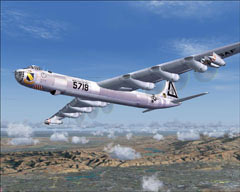
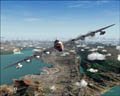
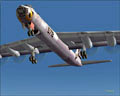
Cruising north out of KSFO
bomb load. The service ceiling was lowered to 40,000 feet as well as the cruise speed, which was reduced to 240 - 300 mph. Ultimately, the B-36 in its many forms would be capable of 6,000+ mile ranges and payload capacities of 72,000 pounds.
The first prototype, designated XB-36, flew on the 8th of August, 1946. A number of problems arose because of the size of the aircraft. YB-36, the second aircraft to hit the skies, flew on the 4th of December, 1947, 60 years ago. This model came with a bubble canopy and more powerful engines. 1948 finally saw the delivery of 21 B-36A’s. Since there were no defensive weapons ready to be implemented into the B-36 at that time, these models went out completely vulnerable. The B-36 did have the advantage of high altitude flight, where it was either very difficult or impossible for any enemy aircraft to reach them in time for an intercept. The aircraft was pressurized, with a tube connecting the fore and aft sections of the plane. Crew would pull themselves along with a rope to go back and forth. When the later models hit the tarmac, the early B-36A’s were all converted into reconnaissance aircraft, which was another role that the Peacemaker was able to fill.
Problems with the early models of the Peacemaker involved engine fires and lack of spare parts. The engine fires were attributed to the fact that carburetor icing occurred. This was due to the carburetors’ not being warmed by the rush of air over the engines, as occurs in a normal setup, i.e., propeller/air intake/cylinders/carburetor. Humid and cold air would cause the air intake to become obstructed, thus enriching the fuel to the point where raw, unburned fuel eventually found its way into the exhaust where it would ignite, causing a fire. This problem led to the first loss of a nuclear weapon, when engine fires caused a B-36 to crash. Later models of the Peacekeeper employed carburetor heating, which rectified the problem.
Problems with the early models of the Peacemaker involved engine fires and lack of spare parts. The engine fires were attributed to the fact that carburetor icing occurred. This was due to the carburetors’ not being warmed by the rush of air over the engines, as occurs in a normal setup, i.e., propeller/air intake/cylinders/carburetor. Humid and cold air would cause the air intake to become obstructed, thus enriching the fuel to the point where raw, unburned fuel eventually found its way into the exhaust where it would ignite, causing a fire. This problem led to the first loss of a nuclear weapon, when engine fires caused a B-36 to crash. Later models of the Peacekeeper employed carburetor heating, which rectified the problem.
A unique configuration
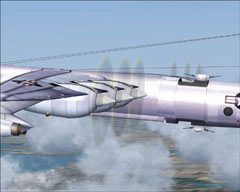
With the advent of the B-36, inter-service budget bickering came to pass, as is usually the case when one branch receives money for a project at the expense of another branch of the service. In this case it was the United States Navy that bitterly opposed the B-36 program, as it was diverting much needed funding away from their own project, that of building a “super carrier”. The Navy wanted a carrier that had the capability to launch either large fleets of aircraft, or bombers capable of carrying nuclear bombs. The USS United States was to be the name of this super carrier, but the project was cancelled by then, Secretary of Defense Louis A. Johnson. There was a bit of controversy surrounding this decision, as Johnson had at one time served on the board of Convair, the maker of the B-36. Sound familiar? The “Revolt of the Admirals” followed this decision, with some leaving the service over this decision. Very soon after this commotion, the Forrestal Class of super carrier came into being. Sometimes it pays to pitch a fit!
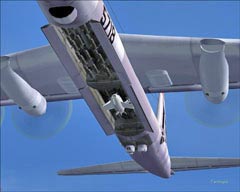
Although the B-36 was more or less obsolete from the word go, being a piston powered rig in a jet jockey world, it was still the only aircraft that could get the job done at the time. The B-47 Stratojet did not become operational until 1953, and even then, it did not have the muscle to carry the early hydrogen bombs, nor did it have the range to get to the USSR from the States. The B-36 had job security for the time being. Under the command of General Curtis LeMay, the Strategic Air Command’s backbone was the B-36, up until the time the B-52 came into service. Although slow and unable to refuel in the air, the B-36 still had more of a load capacity than the B-52, and more than four times that of the B-29.
There were eleven different models of the B-36 in all, for a total of 384 aircraft produced. The variants that came with additional jet engines had higher speeds, but the jets were normally used only for take-off, climbing, and getting out of the blast area. Otherwise they burned too much fuel. Over a third of the bombers made were converted into reconnaissance platforms, with the designation of RB-36. The ability to cruise at high altitudes for 45 - 50 hours at a stretch was perfect for the task of recon. Things were not as compact then as they are now, and the photographic equipment was rather large and bulky, so it worked out well with placing this equipment in one of the bomb bay areas, while the other bomb bay was used to hold extra fuel tanks. Throughout its 10 year career, 1948 - 1958, the B-36 never dropped a bomb or fired a shot at an enemy force.
There were eleven different models of the B-36 in all, for a total of 384 aircraft produced. The variants that came with additional jet engines had higher speeds, but the jets were normally used only for take-off, climbing, and getting out of the blast area. Otherwise they burned too much fuel. Over a third of the bombers made were converted into reconnaissance platforms, with the designation of RB-36. The ability to cruise at high altitudes for 45 - 50 hours at a stretch was perfect for the task of recon. Things were not as compact then as they are now, and the photographic equipment was rather large and bulky, so it worked out well with placing this equipment in one of the bomb bay areas, while the other bomb bay was used to hold extra fuel tanks. Throughout its 10 year career, 1948 - 1958, the B-36 never dropped a bomb or fired a shot at an enemy force.
It never had to leave the bay!
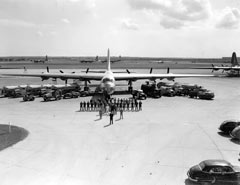
Support staff and crew of a B-36
Maintaining this beast was quite the chore, and required above normal maintenance routines. Supposedly, back in January of 1951, a B-36 racked up 200 hours of flight time. They broke this down as a little over eight standard, twenty-four hour missions. Not too good by today’s standards, but an incredible accomplishment for this particular aircraft! I was unable to find any further information on this matter, but I would imagine that the aircraft was refitted and sent on her way again, and not put out to pasture! Otherwise, those eight missions were awfully expensive!
She was way too big for the majority of hangers, so special shelters were rigged up for ground crews so that they could stay out of the elements while working. Even though the aircraft had an incredible range, they were still placed as close to the “enemy” as possible, which meant anything from hot summers, as in the Pacific, to extremely cold winters, such as Alaska. At altitudes where pressurization was not required, a flight engineer could crawl into the wing, as the wing root was seven feet thick, and access engines and landing gear if it was needed.
Such simple things as changing sparkplugs, which usually had to be done after every flight due to the heavy leaded fuel of the day, proved to be quite the chore, as each of the six piston engines had a total of 56 plugs! That’s 336 spark plugs, or, 336 opportunities to bust your knuckles! WOW! I’m never complaining again when I give the old Chevy a tune-up! As far as
She was way too big for the majority of hangers, so special shelters were rigged up for ground crews so that they could stay out of the elements while working. Even though the aircraft had an incredible range, they were still placed as close to the “enemy” as possible, which meant anything from hot summers, as in the Pacific, to extremely cold winters, such as Alaska. At altitudes where pressurization was not required, a flight engineer could crawl into the wing, as the wing root was seven feet thick, and access engines and landing gear if it was needed.
Such simple things as changing sparkplugs, which usually had to be done after every flight due to the heavy leaded fuel of the day, proved to be quite the chore, as each of the six piston engines had a total of 56 plugs! That’s 336 spark plugs, or, 336 opportunities to bust your knuckles! WOW! I’m never complaining again when I give the old Chevy a tune-up! As far as
changing the oil goes, it was written by a former ground crew member, that he did not personally recall changing oil in the engines as the engines were prone to consume large quantities of oil during a flight. I think he may be exaggerating, but maybe not! Each of these Wasp Major engines required their own 100 gallon tank of oil! Glug-glug-glug!
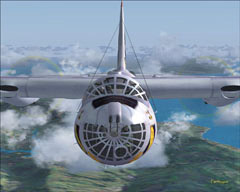
The basic B-36 training mission consisted of a 40 hour sortie, some ground time for maintenance and refueling, then back at it for another 24 hour stint. Remember that these things had the ability to fly incredibly long ranges. The B-36 had crew quarters and a galley in the aft section of the aircraft. I think you can see why! Future “Feather Weight” versions did away with these “amenities”, along with the cannon turrets, in favor of less weight for more range. She was not exactly “roomy” inside, by most accounts. This was in the early days of pressurized compartments, so it’s likely they tried to keep things as small as possible. As far as flying the B-36, most pilots stated that it was not exactly their favorite aircraft to fly. Lieutenant General James Edmundson had said that flying the Peacemaker was like “sitting on your front porch and flying your house around”. Not exactly “fly-by-wire”, hmmmmm?
A typical (if there is such a thing!) war mission for a B-36 during the Cold War era, would not have been a round robin trip. Rather it would have originated at a forward base, such as Alaska, over fly the USSR, then land in Europe. Crews were said to have been confident in being able to complete their assigned mission, but that they did have concerns regarding leaving the blast area in time so as not to sustain damage to their own aircraft. During the Operation Castle tests, B-36’s flew in the area of a 15 megaton detonation, at distances consistent with wartime delivery ranges, and these aircraft did in fact sustain blast damage.
A typical (if there is such a thing!) war mission for a B-36 during the Cold War era, would not have been a round robin trip. Rather it would have originated at a forward base, such as Alaska, over fly the USSR, then land in Europe. Crews were said to have been confident in being able to complete their assigned mission, but that they did have concerns regarding leaving the blast area in time so as not to sustain damage to their own aircraft. During the Operation Castle tests, B-36’s flew in the area of a 15 megaton detonation, at distances consistent with wartime delivery ranges, and these aircraft did in fact sustain blast damage.
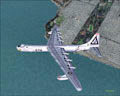
What a view!
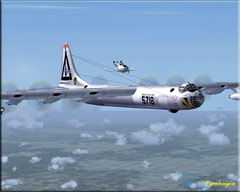
In the “Golden Years” of the Peacemakers existence, it was phased out of its strategic bomber role, now that the B-52 was on board, and it was used more in an experimental role. It was involved in tests for the feasibility of nuclear powered aircraft. It was never actually powered by the atom, but it was rigged to haul a small reactor around in its aft bomb bay to see how both the aircraft and the reactor faired. After 47 test flights and 215 hours of flight time, the program was scrapped. The B-36 was also involved in “Parasite Aircraft” experiments with the F-84 Sabre and the XF-Goblin, which used a trapeze system to dock, much like the old Macon airship and its “parasite” biplanes. Pilots that were experienced found that docking with the mother B-36 could prove to be extremely difficult, even for them, so that program went the way of the Nuke powered aircraft as well. Here’s one more experiment gone wrong involving the B-36. They actually strapped on two F-84 Sabre’s, one under each wing of the B-36 (they did this with a B-29 as well), in the hopes of increasing range. This program was scrapped when a B-29 in this configuration crashed and killed all three pilots.
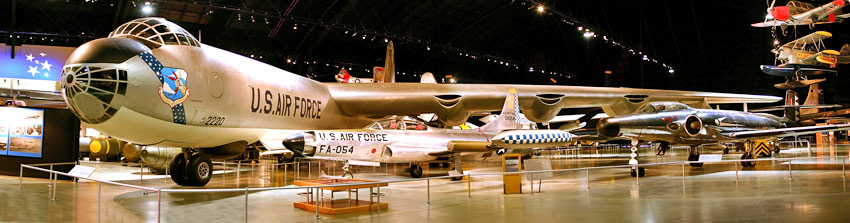
The life of the B-36 ended for a number of reasons, but progress in the field of aviation design was the main factor. With the advent of jet powered bombers capable of even longer ranges, interceptors with the ability to reach altitudes fast, surface to air missiles, all contributed to the retirement of the Peacemaker. Only four complete B-36 Peacemakers exist today.
The life of the B-36 ended for a number of reasons, but progress in the field of aviation design was the main factor. With the advent of jet powered bombers capable of even longer ranges, interceptors with the ability to reach altitudes fast, surface to air missiles, all contributed to the retirement of the Peacemaker. Only four complete B-36 Peacemakers exist today.
Out comes the Goblin to play!
That one-man, aircraft making machine Kazunori Ito, designed this model back in 2005, and it is still a blast to fly, and gives you a taste of those strategic bomber days! First and foremost, find yourself a runway that is at least 11,000 feet long 12,000 feet and you won’t sweat as much!. Believe me when I say that you are going to use every inch of it! With a bit of flap deployed, I was able to rotate at about 170 knots, and this was with the tanks topped off and a full cargo capacity set in the MSFS load out options. Topped off and with a full belly was the norm of the day. I was afraid that I was running out of asphalt when I felt the nose begin to rise ever so slowly, and then she was airborne. Get the gear up fast so that you can build speed quicker. When Lt. Gen Edmundson said it was like flying your house around he was not exaggerating! I can’t really comment on the accuracy of the flight dynamics for obvious reasons (I never flew a B-36!), but it handles like the typical “heavy”.
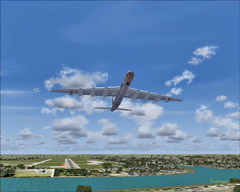
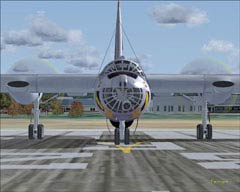
I can't see the end of the runway...
so there should be enough!
so there should be enough!
She needs lots of runway!
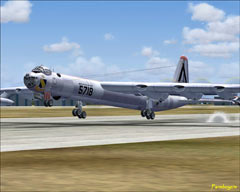
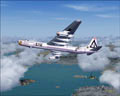
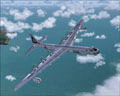
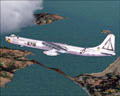
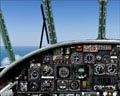
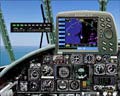
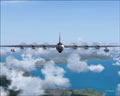
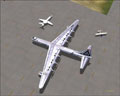
ILS approaches are possible utilizing the Nav1 OBS, and it has a basic, easy to use autopilot system that is accessed through the use of key commands. GPS and autopilot are the only pop up panels. The panel itself is functional, nothing too special; however it is rather authentic looking. Sounds are fairly decent. The modeling of the aircraft looks great. There is only one paint job that comes with the package, reflecting that of the Strategic Bomber Command, and a good job was done in this area, with some great detail painting as well. The animations are very cool, with gun turrets, two on the top of the aircraft and one on the bottom, a bomb bay door that opens to expose a rack of bombs as well as a thermonuclear device, and the cherry on top of all this is the XF Goblin dropping out from the aft bomb bay to fly out and alongside of the B-36. This is a fine freeware model that should be a part of your virtual, strategic bomber wing! It makes for some great screenshots as well! Thanks Kazunori for a job well done! A big thanks to all freeware developers as well!
I hope you enjoyed this step back in aviation history as much as I do! It is great to see these different “flying machines” come alive, once again, in the virtual skies of our simulators!
I hope you enjoyed this step back in aviation history as much as I do! It is great to see these different “flying machines” come alive, once again, in the virtual skies of our simulators!
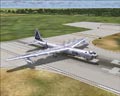
With a bump and a thump, I'm down!

